Moving Data Without Vendor Help
SaaS platforms are designed to feel simple at the start. Oftentimes, the onboarding process is typically quick and effortless, which gives the impression of complete control. All is fine as long as you are within the system. However, without a managed IT support provider, the actual problem comes in when you attempt to exit. Many business owners and managers belatedly realize that it is harder to get out than it was to get in. Plus, there is a tendency for SaaS platforms to release incomplete data exports and lock important information in proprietary data formats. Usually, one that cannot be easily reused or transferred.
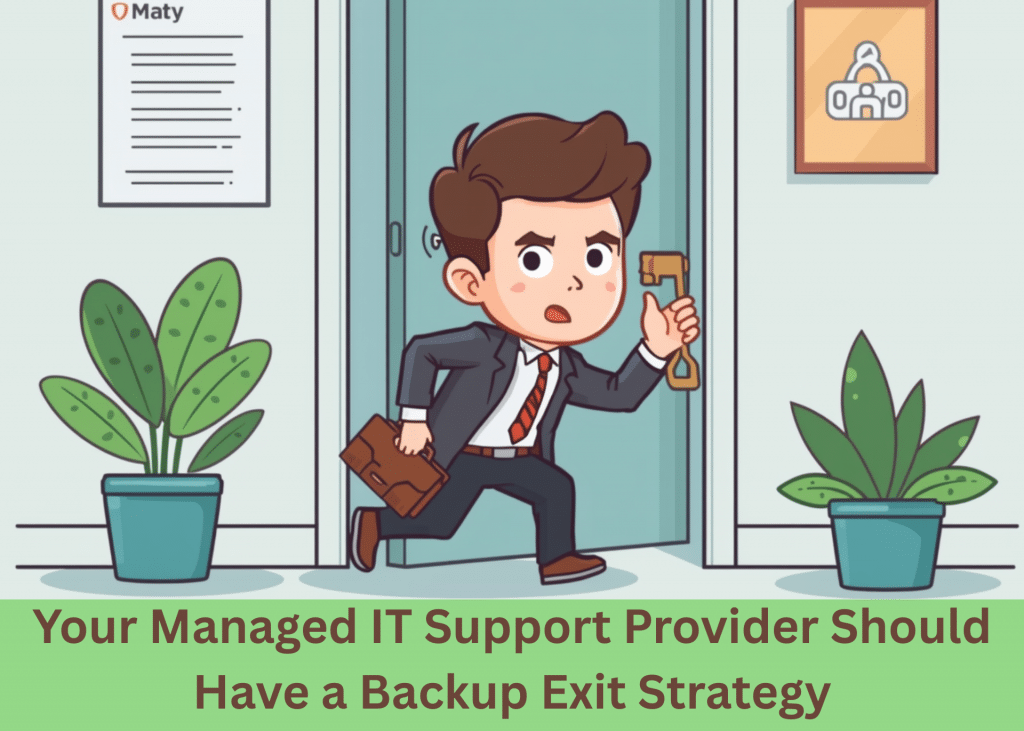
Your Managed IT Support Provider Should Have a Backup Exit Strategy
This system has become a serious limitation in the modern business environment. As companies move to integrate human teams with Agentic AI systems, continuous data flow is necessary to make the transition smooth. But managed IT support experts explain that when data are not able to move freely, control is not a part of an organization but rather quietly rests with the vendor ecosystem.
Why Vendor Lock-In Is Getting Worse in 2026
The vendor lock-in is increasingly becoming frequent as SaaS environments continue to become increasingly interconnected. This comes from the fact that data is not secluded anymore but constantly flowing between systems in a continuous manner. Therefore, implying that most organizations now rely on a variety of platforms that are interconnected through automation, integrations, and shared workflows. This interdependent system causes a ripple effect whenever there is a change. Managed IT support professionals explain that an update on pricing, a feature added or removed, or a policy change will not remain within the scope of one tool. It also impacts related systems and makes what would have been a straightforward replacement into a full migration project that needs to be planned, coordinated, and time sensitized.
Even more complexity is brought about to this situation by security pressure. This is because major breaches are still prevalent in organizations across industries. As a result, they demonstrate how frequently systems are exposed during normal operations. Moreover, credentials and active sessions are also of high interest to attackers due to the fact that credentials and active sessions enable direct access without traditional barriers. This makes migration periods highly sensitive since systems are already authenticated and actively transferring data.
The Financial Cost of the Proprietary Trap
SaaS vendor lock-in places a long-term financial burden that is not necessarily initially obvious. At first, costs might seem to be stable and predictable. However, over time, the system becomes more difficult to adjust, optimize, or replace without causing a significant disruption. This gradual loss of flexibility is what drives long-term inefficiency, explained by a managed IT support provider. Since it makes systems rigid, even the slightest improvement becomes a huge project. As a result, businesses struggle to remove unused tools or shift to better alternatives without triggering complex dependencies. So, what can be easily optimized turns into a slow and costly process of operations.
The deeper issue, however, is the loss of strategic freedom. This is because the issue of pricing and the renewal decision no longer depends on value but rather is a forced decision based on dependency. An effective backup exit strategy with your reliable managed IT support provider is just the reverse and puts the enterprise back under control. As a result, the business is able to migrate on demand and make decisions based on the business value and not on a technical limitation.
Securing the Move During Migration
Experts in managed IT support say that data migration is one of the most sensitive phases in any system lifecycle. This is because massive data transfer is occurring simultaneously with privileged access. Thus, it automatically provides a window of high risk. As such, the migration process has to be tightly regulated as compared to the regular operations. One major threat during this phase is session-based compromise. This is when attackers may not need passwords if they are able to steal active session tokens. With these tokens, it enables them to reuse authenticated access, bypassing traditional login systems, sometimes even multi-factor authentication.
Therefore, to reduce this risk, migration must be handled with strict security discipline. Phishing-resistant authentication, for example, must be used where possible. Likewise, session time should be minimized, and actions that should be sensitive should be re-authenticated. Additionally, migration devices should also be under complete control, patched, and constantly monitored to identify unusual activity in real time.
Ownership is a Discipline
The business environment that modern businesses operate in is one where tools are always in a state of flux. This means platforms evolve, vendors shift direction, and systems become more interconnected every year. In this kind of environment, flexibility is not optional but essential for survival. That is why ownership is more than merely using software. It is the result of making sure that data is organized, transportable, and does not exist within a single ecosystem. By designing systems that have the ability to exit, the businesses are able to stay in control as tools are developed around them. To make this possible, a powerful backup exit strategy, planned with your managed IT support provider, ensures that migration is not an emergency response but a planned capability. Hence, safeguarding control, mitigates risk, and makes business decisions entirely within the control of the organization and not the vendor.
So, is your vendor making it hard for your business? We can help!
Talk to us today!
Watch Our Latest Tech Videos From EB Solution

Get A Free Immediate Quote For IT Services
From EB Solution Today.
Why choose EB Solution:
- Around-the-clock IT services
- Expert technology professionals
- Single source for all your IT
- Reliable data backup solutions
- Certified cybersecurity experts
Ready to make the move to EB Solution?
Fill out the form to the right to get your free immediate quote.
Interested?
 Call Now