
Why Voice Cloning is the New Business Fraud Threat
The telephone rings, and the caller is recognizable. It is your boss and the voice matches perfectly. The tone feels right, plus they sound urgent and direct. A request follows quickly, and they require authorization for a wire transfer. Or they require client data in their hands. There is nothing that is out of the ordinary, and you are ready to oblige. But before you act on it, an IT consultant warns: the voice may not be real! All words might be unnatural; pauses could be created, and trust turns into a weapon in seconds. From this, money disappears, data leaks, and the influence does not just remain in a single department. Unfortunately, the healing process is slow and painful.
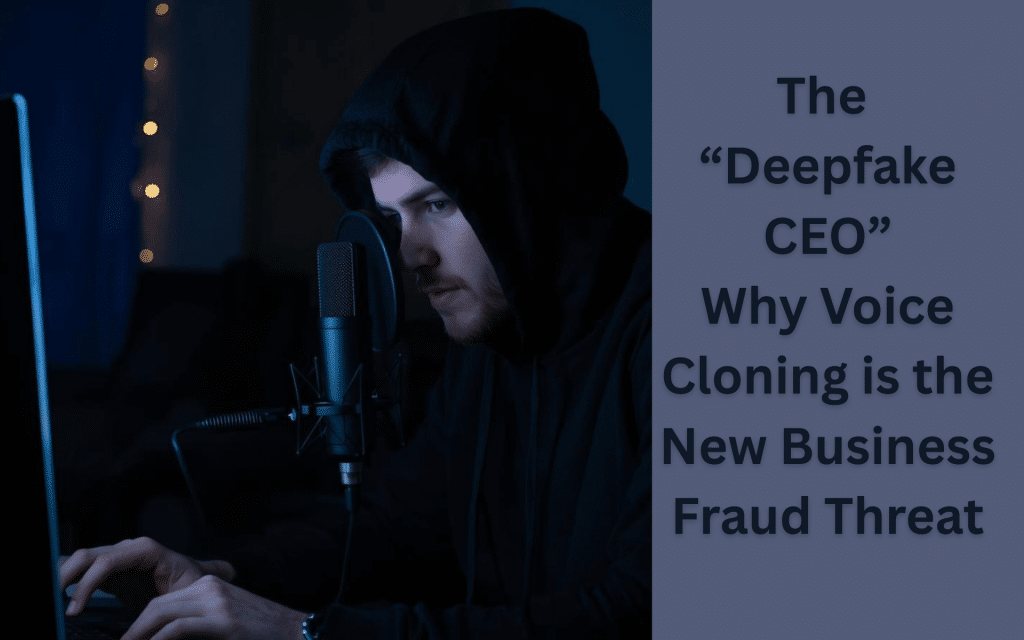
IT Consultant Scam Alert The “Deepfake CEO”
This used to be fiction, but an IT consultant emphasizes that what was once unimaginable has become a business threat. Phishing emails are no longer the only way used by cybercriminals. They are now using AI voice cloning to impersonate executives, which is a worrying development in corporate fraud.
AI Voice Cloning Reshapes Modern Attacks, IT Consultant Shares
Organizations took years to learn how to detect email threats. Employees are aware of checking domains and grammar. They search for suspicious attachments. But few consider questioning a voice that is familiar. As such, hackers take advantage of this vulnerability. Since audio can last only a few seconds, public recordings work well. Published interviews, webinars, presentations, and social posts would be enough to piece together a conversation. The attackers only need to capture feed samples into AI voice tools, and it produces speech from typed words. The result is a sound that is alarmingly realistic. This works as entry barriers is low. This means hackers do not require high-level technical expertise; all they need is an AI platform that is accessible and convenient. Therefore, any person who has basic access can identify as a company executive and this availability increases the threat space exponentially.
Business Email Compromise Enters a New Phase
For conventional businesses, email fraud was based on text manipulation. This is when hackers spoofed or hijacked accounts and employees are deceived into sending money or information. Over time, however, employee training and improved filters made detection easier. Unfortunately, these defenses are bypassed by voice-based attacks. This is because, unlike emails, there are no headers to look into and no links to hover over. Hackers exploit workers’ emotional and instinct-based reactions that play in whenever the voice is urgent. Voice phishing (vishing) is based on human behavior wherein attackers generate urgency and pressure. Hence, victims often think the issue must be fixed immediately, and verification is substituted with speed. This psychological change renders voice scams much more efficient.
Why Voice Cloning Scams Succeed So Easily
These attacks use hierarchy in organizations. They take advantage of the fact that the staff is trained to obey management and that it is out of order to challenge an executive request. According to an IT consultant, this social conditioning is what the attackers depend on along with the right timing. This is because the most frequent calls are made on the weekends or holidays where verification is more difficult. Hence, support personnel might be out, and victims are isolated and pressured in a hurry. Furthermore, the attack is reinforced by emotional manipulation. AI voices are made to be convincingly stressed and frustrated, hence sending emotional signals that interfere with rational thought. During this time, said an IT consultant, caution is lowered as emotions increase thereby making it easy to exploit.
Detecting Audio Deepfakes, A Challenge for Today’s IT Team, Says IT Consultant
For now, it is still very hard to spot the fake audio. This is because human beings are poor judges and usually, in a conversation, the brain fills gaps automatically. As such, the voices that are familiar are real despite their imperfections although some signs still exist that you and your team can try to familiarize yourselves with. For example, voice can be a little robotic and complex words may be distorted. Additionally, breathing is not natural, and background noise can appear to be inconsistent. Moreover, personal habits may feel off. Despite these, it should be noted that they can still be vague and inconsistent.
For an IT consultant, it is dangerous to merely rely on detection. This is because the quality of AI is still rising at a high rate and eventually, there will be very minimal, if not none, flaws in voice scams. Because of this, having an internal processes of verification becomes more powerful in defense than human intuition.
Why Security Awareness Training Must Adapt
Most training programs are obsolete, according to an IT consultant. This is because most training syllabus pay attention to passwords and email links. They usually do not include new threats that need more awareness. In reality, however, employees should know that voices are counterfeited. In the same vein, AI-based attack scenarios should be part of the training. Exercises that simulate real life scenarios that test reactions under pressure should be included so as to develop muscle memory. With this, employees make it a habit of checking, not just trusting. Moreover, training needs to focus on high-risk positions. For now, finance departments are still the main targets along with CEOs, HR, and IT executives are the targets of these hackers. Additionally, the access of executive assistants is privileged. Therefore, the awareness should cut across departments.
Building Strong Verification Protocols
The most effective protection is provided by verification protocols. This means that any voice requests that involve money or data should be verified personally, without exception. In case a call demands an urgent action, stop. Ensure to authenticate through a second channel. For example, dial in the executive through an internal directory or maybe send a message using encrypted collaboration platforms. Any confirmation must never be made on the spot. Moreover, employing shared challenge phrases or internal code words can be useful. Such techniques create friction for attackers and in case of a failure of verification, the request is rejected.
The Future of Identity and Trust
Digital identity is turning fluid. This means voice is no longer valid evidence, and confirmation through actions of high value might need re-confirmation in person. Additionally, voice validation can be supported in the near future with cryptographic identity. Until that time, deceleration of processes is effective. This is because attackers are dependent on haste and panic. These intentional pauses will break their victory. Hence, verification delays do not hurt productivity in organizations.
Protecting Against Synthetic Threats
Unfortunately, the dangers of deepfakes do not begin and end with financial loss. There is an instant spread of reputational damage as well. These counterfeit audio or videos can go online, and before the truth comes out, stock prices could have already dipped and can have corresponding legal repercussions. Additionally, organizations should have response plans for synthetic media incidents. Voice scams are just the tip of the iceberg. Before long, video deepfakes will follow. Hence, businesses should understand how to counter false media in a short period of time. Preparing in advance is better than responding afterward as early preparation minimizes the effects and time of recovery. Powerful processes safeguard property and reputation.
Are your verification controls ready to handle this threat? Talk to one of our expert IT and cybersecurity professionals today!
Call us now!
Tech Insights From EB Solution
Watch Our Latest Tech Videos From EB Solution

Get A Free Immediate Quote For IT Services
From EB Solution Today.
Why choose EB Solution:
- Around-the-clock IT services
- Expert technology professionals
- Single source for all your IT
- Reliable data backup solutions
- Certified cybersecurity experts
Ready to make the move to EB Solution?
Fill out the form to the right to get your free immediate quote.
Interested?
 Call Now