
Close the Gaps That Matter
The majority of small businesses have a concerning cybersecurity stance. This is because many setups grow over time by adding tools to fix one-time issues. As a result, it creates a patchwork of solutions that sometimes overlap without reason. In some cases, they even leave holes in what is supposed to be a layer of protection. This lack of long-term strategy, although it appears solid on the surface, does not really align well. Thus, cybersecurity firms recommend steering away from this weak approach. Oftentimes, these weaknesses remain unnoticed in day-to-day operations. This is because they do not often show up in the regular IT work process. Rather, they are noticed only when actual accidents happen. Then, it is when loopholes become costly issues.
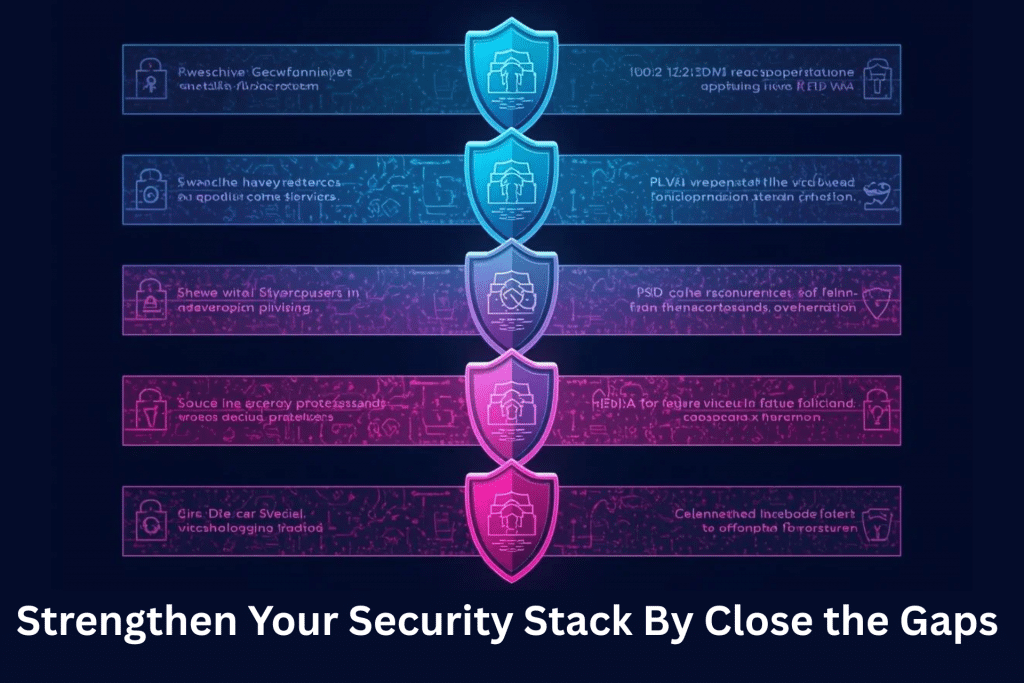
Cybersecurity Firms’ Hack Strengthening Your Security Stack
Layered Security Matters in 2026
A single control is no longer sufficient as an element of security today. This is because attackers do not follow predictable paths. Instead, they seek the simplest point to exploit. Making every security gap a sitting target, waiting to be exploited in a landscape wherein threats are changing at a very fast rate. Among these, AI is one of the key agents of change noted by the World Economic Forum to revolutionize both cyber threats and cyber security. Since attacks are increasingly becoming more intelligent, quicker, and focused, cybersecurity firms should not fall behind in closing gaps to prevent infiltration.
As such, change needs to come in the form of a layered security process. This is especially true as companies cannot afford to remain at the basic protection. Additionally, security should not only be written but also enforced so that it becomes operational. Moreover, consistent evaluations are emphasized as an important part in ensuring gaps are identified at an early stage.
Cybersecurity Firms Thinking Through Outcomes
In this case, security is simple to enhance. This starts by getting out of thinking about tools and focusing, instead, on outcomes. One of the useful models is provided by the National Institute of Standards and Technology framework. It breaks down security into six major aspects, namely, governance, identification, protection, detection, response, and recovery.
In this framework, every area provides an answer to a key question, as to wit:
- Who owns decisions?
- What needs protection?
- What is the speed of detection of threats?
- What occurs following an event?
- What do you do to bounce back?
In most small businesses, the approach is very protection oriented. Although some have a fair idea of what identification is, there are the usual significant gaps in governance, detection, response, and recovery.
The Five Security Layers Often Overlooked
Enhancing the main layers enhances general resilience. Additionally, it also reduces reliance on luck. The following are the five areas that are usually lacking or weak as identified by reliable cybersecurity firms.
Phishing-Resistant Authentication
Basic multi-factor authentication is a strong start, but it may no longer be enough today. Cybersecurity firms say that advanced phishing attacks can still bypass some of these methods. Therefore, secure authentication needs to be applied everywhere. Moreover, access controls are needed in sensitive systems. This includes removal of outdated login methods that weaken protection. Furthermore, using risk-based rules for unusual login behavior is an essential addition to the defense. This is because it ensures that access is checked appropriately every time.
Device Trust and Usage Standards
Devices in most businesses, although logged, are often overlooked when it comes to security. Hence, creating inconsistency across the environment. Because of this, establishing a standard of trusted devices is essential. Guidelines on the use of personal devices must be clear, written, and enforced consistently. As a result, if a device fails to meet standards, access is limited. Strict compliance must be demanded, and enforcement should not rely on reminders alone. Having this, according to cybersecurity firms, leads to establishing a routine.
Email and User Risk Controls
In most attacks, the primary point of entry is through email. Although user awareness is good. However, awareness alone is risky as people make mistakes, especially under pressure. Hence, powerful controls should be in place to minimize exposure automatically. This means blocking suspicious links and attachments as well as lookalike domains or any impersonation attempts before user interaction. In the same vein, cybersecurity firms also encourage having an easy and judgement-free means of reporting any possible threats. These high-risk actions should be guided by clear processes. This minimizes harm due to innocent mistakes.
Continuous Vulnerability and Patch Coverage
Patching is said to be managed by many businesses. However, the fact is, it is not usually consistent. This is because of the general lack of visibility into missing updates. Ideally, there should be an established time limit on the basis of risk severity. This means that important problems should be resolved promptly whereas less critical updates must have a systematic schedule. In this case, cybersecurity firms recommend having third-party applications in order to follow up on track exceptions. This ensures that they do not turn into long-term risks.
Detection and Response Readiness
The majority of systems issue alerts continuously. But the challenge is in taking action on them. In these instances, alerts become nothing but noise without structure. Therefore, to mitigate this, there should be a clear definition of your monitoring baseline. This means urgent threats are identified from routine events. Having this segregation enhances the speed and accuracy of responses. Furthermore, there should be simple action plans for common scenarios as well as regular test recovery processes. Having real-world testing means being ready when required.
Building a Strong Security Baseline
By reinforcing these layers, you create a consistent, measurable, and manageable cyber security system that is not reliant on luck anymore. Cybersecurity firms clarify that this process does not need to be overwhelming. You can start with your weakest area first, improve it, and then standardize the process. When stable, take the next layer. In the long run, this strategy develops a solid base. Additionally, it also reduces risk without adding unnecessary complexity. Hence, security does not become a daily task but a part of operations.
Do you need help with these strategies?
Call us today!
Watch Our Latest Tech Videos From EB Solution

Get A Free Immediate Quote For IT Services
From EB Solution Today.
Why choose EB Solution:
- Around-the-clock IT services
- Expert technology professionals
- Single source for all your IT
- Reliable data backup solutions
- Certified cybersecurity experts
Ready to make the move to EB Solution?
Fill out the form to the right to get your free immediate quote.
Interested?
 Call Now